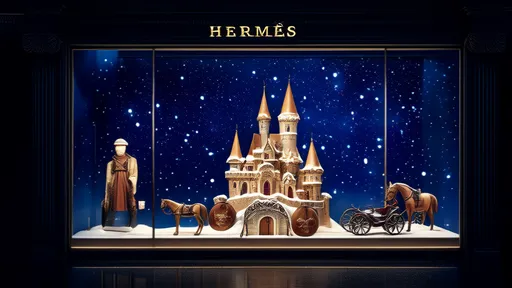
In the hushed glow of Parisian twilight, where the Seine mirrors the city's golden lights, Hermès transforms its vitrines into portals of enchantment. The maison's holiday windows this year don't merely display merchandise—they stage a sartorial fairy tale where leather becomes forest foliage and silk scarves morph into rivers of liquid color. This is window storytelling at its most alchemical, where commercial space dissolves into narrative wonder.
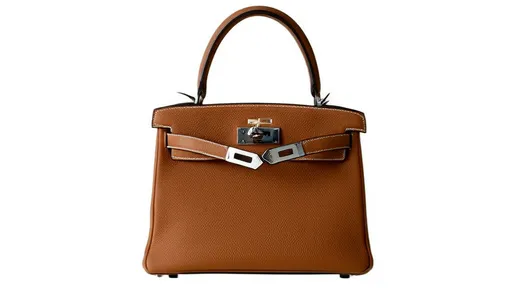
The left window presents a frozen moment from an imaginary Nordic legend. A life-sized carousel horse crafted from Barenia leather rears mid-gallop, its saddle stitched with the precision of medieval armor. Frosted glass panels behind it refract light into prismatic patterns that dance across Hermès' iconic Kelly bags arranged like treasure chests at its hooves. What astonishes isn't the technical mastery—expected from Hermès' artisans—but how the cold, metallic scent of winter seems to permeate the glass barrier.
Central to the display stands a mechanical theater of miniature artisans. Tiny automatons clad in replica 1930s work aprons hammer at anvils, their repetitive motions crafting microscopic versions of the very bags displayed alongside them. This mise en abyme effect—craftsmen crafting the tools that craft the objects—reveals Hermès' narrative genius. The windows don't just tell stories; they embed the viewer within the mythology of creation itself.
To the right, the scene shifts abruptly to equatorial warmth. A jacquard jungle erupts from the display floor, its vines woven from reimagined Chaîne d'Ancre motifs. Emerald crocodile skin wallets nest like exotic birds amidst foliage embroidered with silk thread so fine it trembles when subway trains pass beneath the boulevard. Here, Hermès' chromatic brilliance reveals itself—the same orange boxes that signify luxury in daylight now glow like bioluminescent fungi under carefully positioned UV lamps.
The true marvel lies in the olfactory dimension. Through nearly invisible vents, the scent of saddle soap and hothouse gardenias wafts into the viewing space. This multisensory approach transforms passive observation into embodied experience. A woman pressing her nose against the glass isn't merely shopping—she's remembering a childhood storybook she can't quite name, where horses could fly and trees bore jeweled fruit.
Critics might dismiss such displays as extravagant marketing. Yet Hermès' windows function as cultural palimpsests, layering contemporary craftsmanship over archetypal narratives. The carousel horse echoes Pegasus and Sleipnir; the artisan automatons recall Hephaestus' forge; the silk jungle evokes both Rousseau's paintings and Baudelaire's "Invitation to the Voyage." This isn't decoration—it's the maison conversing with centuries of visual poetry.
As midnight approaches, the windows undergo their final transformation. Motion sensors trigger a lunar cycle of lighting changes. The Nordic scene floods with artificial moonlight that makes frost patterns creep across the glass. In the jungle display, fiber optic "fireflies" awaken to dance around the leather foliage. This circadian rhythm suggests the windows exist independently of human observation—they don't pause their stories when the street empties.
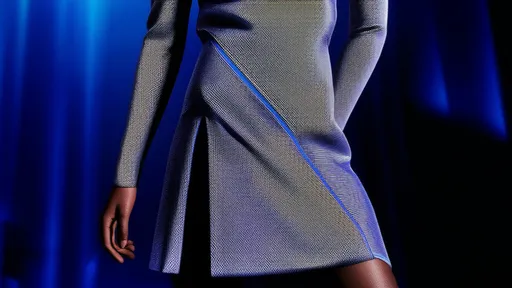
The genius of Hermès' approach lies in its resistance to literalism. Unlike competitors who illustrate specific fairytales, these displays conjure the essence of storytelling itself—that shiver of recognition when pattern recognition fails, when the mind grasps at half-remembered myths. A tweed coat becomes a wolf's pelt; a stacked porcelain dinner service transforms into a frozen banquet from the Snow Queen's palace. The viewer completes the narrative.
Perhaps most remarkably, the windows acknowledge their own temporality. Come January, artisans will dismantle these dreamscapes with the same reverence accorded to museum deinstallations. The leather horse will return to storage; the mechanical theater will power down. This ephemerality mirrors the nature of oral folklore—stories told, then dissolved back into the cultural ether until the next seasonal cycle begins.
In an era of digital overload, Hermès proves the irreplaceable power of physical wonder. No Instagram filter can replicate the way chilled Parisian air fogs the glass as breathless children press against it, or how the scent of vegetable-tanned leather mingles with winter chestnuts from street vendors. These windows don't just sell products—they sell the re-enchantment of the everyday, proving luxury isn't about ownership, but about privileged moments of astonishment.
By /Aug 1, 2025

By /Aug 1, 2025
By /Aug 1, 2025
By /Aug 1, 2025

By /Aug 1, 2025

By /Aug 1, 2025

By /Aug 1, 2025
By /Aug 1, 2025

By /Aug 1, 2025
By /Aug 1, 2025

By /Aug 1, 2025

By /Aug 1, 2025
By /Aug 1, 2025
By /Aug 1, 2025
By /Aug 1, 2025
By /Aug 1, 2025

By /Aug 1, 2025
By /Aug 1, 2025

By /Aug 1, 2025
By /Aug 1, 2025
