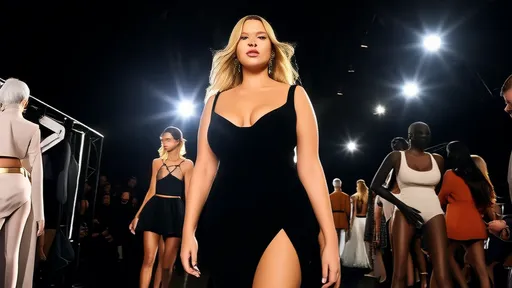
The fashion industry has long been criticized for its narrow beauty standards, but a quiet revolution has been unfolding on the runways of New York, London, Milan, and Paris. Over the past five seasons, the presence of plus-size models at the Four Major Fashion Weeks has grown from token appearances to meaningful representation, signaling a fundamental shift in how the industry perceives beauty and market viability.
The Changing Landscape of Fashion Week
Where once sample sizes barely accommodated a US size 4, designers are now creating runway pieces that celebrate diverse body types. This season marked a turning point, with plus-size models walking in over 30% more shows compared to Spring/Summer 2023. The change isn't just quantitative - it's qualitative. These models are no longer confined to "special" inclusivity-focused shows, but are being cast in major luxury presentations alongside straight-size counterparts.
London Fashion Week emerged as the most size-inclusive, with 18% of shows featuring at least one plus-size model. British designers like Sinead Gorey and Karoline Vitto sent curve models down the runway in looks that celebrated rather than concealed their proportions. New York followed closely at 15%, with commercial brands like Coach and Michael Kors leading the charge. European runways showed slower progress - Milan at 9% and Paris at just 7% - but even these traditional fashion capitals demonstrated more diversity than previous seasons.
Beyond Tokenism: The New Generation of Plus-Size Stars
The current wave of plus-size representation differs fundamentally from earlier attempts at inclusivity. Where past seasons might feature one "token" curve model per show, we're now seeing multiple plus-size models in single presentations. More significantly, these models are walking in shows where the entire collection includes extended sizing, rather than having one or two specially made pieces.
Models like Paloma Elsesser, Jill Kortleve, and Precious Lee have become regular faces at major houses. Elsesser's appearance in Fendi's Fall/Winter show marked the first time a size-16 model opened for the Italian luxury brand. Kortleve has walked for brands ranging from Versace to Jacquemus, proving that high fashion and body diversity aren't mutually exclusive. These women aren't just breaking barriers - they're redefining what it means to be a fashion icon.
The Business Case for Size Diversity
Behind this aesthetic shift lies compelling commercial logic. The plus-size apparel market represents a $24 billion opportunity in the U.S. alone, yet many luxury brands have been slow to tap into this demand. As direct-to-consumer brands like Universal Standard and 11 Honoré demonstrate the profitability of inclusive sizing, traditional fashion houses are recognizing that runway diversity isn't just about social responsibility - it's smart business.
Several influential designers have spoken about the creative liberation that comes with designing for diverse bodies. "When you're not constrained by the need to make everything look good on a single body type, you actually become more innovative with silhouettes," explained one creative director who requested anonymity. This season saw bold experiments with volume, draping, and proportion that likely wouldn't have emerged from working exclusively with sample-size models.
Challenges and Backlash
Despite progress, significant hurdles remain. Many established designers still resist working with plus-size models, citing everything from pattern-making difficulties to aesthetic preferences. Backstage, plus-size models frequently report having fewer outfit options than their straight-size counterparts, or being styled in ways that minimize rather than celebrate their curves.
The industry also faces criticism for what some call "performative inclusivity" - using one or two plus-size models to check a diversity box without committing to meaningful change. "We don't just want to be included, we want to be centered," says model and activist Tess Holliday. "That means having the same opportunities, the same variety of looks, and the same creative challenges as any other model."
The Future of Fashion Week
As consumer demand for representation grows, analysts predict we'll see the Four Major Fashion Weeks continue evolving toward genuine size diversity. Younger designers, particularly those from marginalized communities, are leading this charge by building size inclusivity into their brands from inception rather than as an afterthought.
The next frontier? Expanding age and ability diversity alongside size representation. Some forward-thinking shows this season featured models across a spectrum of sizes, ages, and abilities - suggesting that the industry may finally be moving toward a more holistic understanding of beauty. While the pace of change frustrates many, the direction is unmistakable: fashion week will never again be the exclusive domain of a single body type.
What began as tentative steps toward inclusivity has become an irreversible movement. The Four Major Fashion Weeks may never perfectly reflect the diversity of the people who love fashion, but each season brings us closer to that ideal. In an industry built on dreams, perhaps the most beautiful dream of all is one where everyone can see themselves on the runway.
By /Aug 1, 2025

By /Aug 1, 2025
By /Aug 1, 2025
By /Aug 1, 2025

By /Aug 1, 2025
By /Aug 1, 2025
By /Aug 1, 2025
By /Aug 1, 2025
By /Aug 1, 2025
By /Aug 1, 2025
By /Aug 1, 2025

By /Aug 1, 2025
By /Aug 1, 2025
By /Aug 1, 2025

By /Aug 1, 2025
By /Aug 1, 2025

By /Aug 1, 2025
By /Aug 1, 2025
By /Aug 1, 2025
By /Aug 1, 2025
