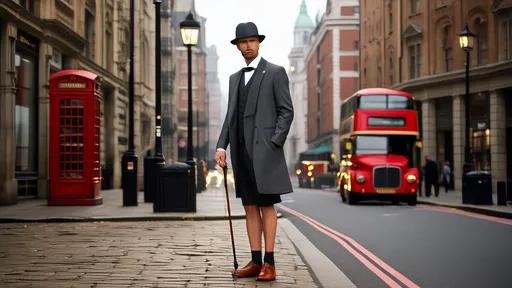
The streets of London's West End hum with a quiet sartorial revolution. Where fast fashion once dominated the pavements around Savile Row and Jermyn Street, a growing contingent of well-heeled gentlemen now move with deliberate elegance in fully canvassed three-piece suits. This isn't about nostalgia - it's a conscious rejection of disposable style in favor of craftsmanship that breathes.
Tailors report waiting lists stretching six months for bespoke waistcoats, a garment that disappeared from most men's wardrobes by the 1990s. "The three-piece suit allows for tremendous self-expression," explains Maurice Sedwell head cutter Rory Duffy as he sculpts a length of Lesser 13-ounce tweed. "Remove the jacket and your waistcoat becomes a frame for your shirt, tie, and personality. It's armor that adapts."
Contemporary adopters aren't replicating their grandfathers' style. The new three-piece silhouette features higher armholes for mobility, slightly shorter jackets to showcase the waistcoat, and trousers cut for movement. Fabrics range from traditional fresco wools to innovative blends with stretch, while the waistcoat itself has shed its stuffiness through open backs and breathable linings.
Financial analyst James Whitcombe, 32, represents the modern convert. "In meetings, the three-piece commands respect without saying a word. After hours, I'll lose the jacket and roll up my sleeves - suddenly it's rakish rather than formal." This versatility explains why three-piece orders at Richard James have increased 40% year-on-year, with under-35s accounting for most growth.
The revival taps into deeper cultural currents. As remote work erodes office dress codes, the three-piece becomes a choice rather than an obligation. Social media influencers like The Dapper Lou demonstrate how to mix vintage waistcoats with contemporary streetwear, while sustainability concerns drive interest in garments designed to last decades.
Savile Row's younger tailors have responded with workshops on three-piece styling. "We teach clients to treat it like separates," says Huntsman's head cutter Patrick Grant. "A navy suit waistcoat works equally well with grey flannel trousers. The pocket watch chain? That stays in 1923 where it belongs."
Even accessories have evolved to complement this new take on tradition. Slimmer briefcases replace bulky attachés, while minimalist watches allow the suit's construction to shine. The most striking innovation comes from Japanese designer Daita Kimura, whose "hidden waistcoat" features interior pockets for smartphones without disrupting the silhouette.
This renaissance faces one ironic challenge: the very craftsmanship sustaining it. With only 2,000 fully trained master tailors remaining worldwide, producing a proper three-piece suit (requiring 50+ hours of handwork) creates bottlenecks. Some houses now offer "benchmade" alternatives - machine-assisted but retaining key hand elements - to meet demand without compromising quality.
The three-piece's return signals more than a fashion cycle. In an age of digital abstraction, it represents the physical pleasure of wool against skin, the satisfying click of a well-fitted sleeve, and most radically - the idea that dressing should be an act of joy rather than haste. As one young barrister told me outside the Royal Courts of Justice, adjusting his vintage waistcoat: "This isn't costume. It's the most modern thing I own - because it will still be perfect in twenty years."
Across London's clubland, the sight of men in three-pieces debating over whisky no longer reads as antiquarian theater. The cut of their shoulders speaks to something timeless being rediscovered - not how gentlemen used to dress, but how they might dress again.
By /Aug 1, 2025

By /Aug 1, 2025
By /Aug 1, 2025
By /Aug 1, 2025

By /Aug 1, 2025
By /Aug 1, 2025
By /Aug 1, 2025
By /Aug 1, 2025

By /Aug 1, 2025

By /Aug 1, 2025

By /Aug 1, 2025

By /Aug 1, 2025
By /Aug 1, 2025
By /Aug 1, 2025

By /Aug 1, 2025
By /Aug 1, 2025

By /Aug 1, 2025
By /Aug 1, 2025

By /Aug 1, 2025
By /Aug 1, 2025
